Experimentelle Charakterisierung der Wärmehülle der Erde

Elemente der Naturwissenschaft 123, 2025, P. 45-68 | DOI: 10.18756/edn.123.45

Abstract:

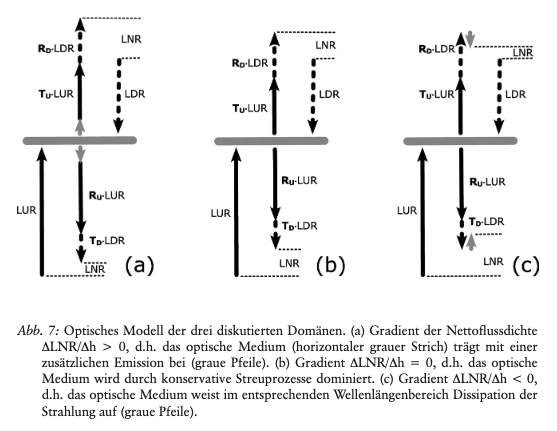
The complex interplay between the biosphere, lithosphere, hydrosphere, and atmosphere – with their dynamic properties governing the planet’s warmth and energy balance – must ultimately be reflected in a manageable number of radiative-physical parameters, which in turn also influence these Earth spheres. In this study, the radiative-physical parameters were measured as a function of altitude in the troposphere and stratosphere using a balloon-borne sensor platform. Analysis of the net radiative flux enabled the distinction of three optical domains that characterize the interaction between terrestrial thermal radiation and different atmospheric layers. In particular, the data demonstrate that very dry atmospheric layers are dominated by scattering processes, whereas layers with high water vapor content increasingly exhibit absorption and emission phenomena. Owing to the inherently non-local nature of thermal radiation – which traverses the atmosphere from the Earth’s surface into space – the exchange of heat between Earth and the cosmos should not be viewed merely as an epiphenomenon of local atmospheric processes and parameters. Instead, it should be understood as an integral component of the Earth’s autonomous thermal organization.
 

References
  • Asano, S., Yoshida, Y., Miyake, Y., Nakamura, K. (2004): Development of a radiometer-sonde for simultaneously measuring the downward and upward broadband fluxes of shortwave and longwave radiation. Journal of the Meteorological Society of Japan. Ser. II 82/2, S. 623– 637.
  • Becker, R., Maturilli, M., Philipona, R., Behrens, K. (2020): In Situ Sounding of Radiative Flux Profiles through the Arctic Lower Troposphere. Bulletin of Atmospheric Science and Technology 1/2, S. 155–177. https://doi.org/10.1007/s42865-020-00011-8.
  • Chandrasekhar, S. (1960): Radiative Transfer. 2nd edition. New York.
  • Elsasser, W.M. (1942): Heat transfer by infrared radiation in the atmosphere. Harvard Meteor. Studies 6, Milton (Mass.)
  • Forštnerič Lesjak, V., Rang, M., Simon, M. (2025): Goetheanism as a contribution to sustainable development. In: Kronenberg, J., Lammerts van Bueren, E. (Hg.): On the Earth We Want to Live. Anthroposophy’s Contributions to Sustainable Development. World Sustainability Series. Cham, S. 212–228.
  • Hansen, J., Nazarenko, L., Ruedy, R., Sato, M., Willis, J., Del Genio, A., Koch, D., Lacis, A., Lo, K., Menon, S., et al. (2005): Earth’s energy imbalance: Confirmation and implications. science 308/5727, S. 1431–1435.
  • Hulst, H.C. van de (2000): Reciprocity relations in radiative transfer by spherical clouds. Journal of Quantitative Spectroscopy and Radiative Transfer 64/2, S. 151–172. https://doi.org/10.1016/S0022- 4073(99)00110-7.
  • Kirchhoff, G. (1860): Über das Verhältnis zwischen dem Emissionsvermögen und Absorptionsvermögen der Körper für Wärme und Licht. Poggendorfs Annalen, (= Ann. d. Phys. 185), Bd. 109, S. 275–301.
  • Koll, D.D.B., Cronin, T.W. (2018): Earth’s Outgoing Longwave Radiation Linear Due to H2O Greenhouse Effect. Physical Sciences. Proceedings of the National Academy of Sciences 115/41, S. 10293–10298. https:// doi.org/10.1073/pnas.1809868115.
  • Kräuchi, A., Philipona, R. (2016a): Return glider radiosonde for in situ upper-air research measurements. Atmospheric Measurement Techniques 9/6, S. 2535–2544.
  • Kräuchi, A., Philipona, R., Romanens, G., Hurst, D.F., Hall, E.G., Jordan, A.F. (2016b): Controlled weather balloon ascents and descents for atmospheric research and climate monitoring. Atmospheric measurement techniques 9/3, S. 929–938.
  • Lovelock, J.E., Margulis, L. (1974): Homeostatic tendencies of the Earth’s atmosphere. Origins of Life 5/1, S. 93–103.
  • Manabe, S., Wetherald, R.T. (1967): Thermal equilibrium of the atmosphere with a given distribution of relative humidity. J. atmos. Sci 24/3, S. 241–259.
  • Mie, G. (1908): Beiträge zur Optik trüber Medien, speziell kolloidaler Metallösungen. Annalen der physik 330/3, S. 377–445.
  • Paltridge, G.W., Sargent. S.L. (1971): Solar and thermal radiation measurements to 32 km at low solar elevations. Journal of Atmospheric Sciences 28/2, S. 242–253.
  • Philipona, R., Kräuchi, A., Brocard, E. (2012): Solar and thermal radiation profiles and radiative forcing measured through the atmosphere. Geophysical research letters 39/ 3, L13806. https://doi. org/10.1029/2012GL052087
  • Philipona, R., Kräuchi, A., Romanens, G., Levrat, G., Ruppert, P., Brocard, E., Jeannet, P., Ruffieux, D., Calpini, B. (2013): Solar and thermal radiation errors on upper-air radiosonde temperature measurements. Journal of Atmospheric and Oceanic Technology 30/10, S. 2382–2393.
  • Philipona, R., Kräuchi, A., Kivi, R., Peter, T., Wild, M., Dirksen, R., Fujiwara, M., Sekiguchi, M., Hurst, D.F., Becker, R. (2020): Balloon-borne radiation measurements demonstrate radiative forcing by water vapor and clouds. Meteorol. Z. (Contrib. Atm. Sci.) 29/6, S. 501–509.
  • Potton, R.J. (2004): Reciprocity in optics. Reports on Progress in Physics 67/5, S. 717–754. https://doi.org/10.1088/0034-4885/67/5/R03
  • Rayleigh, L. (1900): On the law of reciprocity in diffuse reflexion. Philosophical Magazine 49/298, S. 324–325. https://doi. org/10.1080/14786440009463850.
  • Strutt, J.W. (Lord Rayleigh) (1871): XV. On the light from the sky, its polarization and colour. The London, Edinburgh, and Dublin Philosophical Magazine and Journal of Science 41/271, S. 107–120. https://doi.org/10.1080/14786447108640452
  • Sekera, Z. (1970): Reciprocity relations for diffuse reflection and transmission of radiative transfer in the planetary atmosphere. Astrophysical Journal 162, S. 3–16.
  • Schuckmann, K. von, Palmer, M.D., Trenberth, K.E. et al. (2016): An imperative to monitor Earth’s energy imbalance. Nature Climate Change 6/2, S. 138–144.
  • Schuster, A. (1905): Radiation through a foggy atmosphere. Astrophysical Journal 21, S. 1–22.
  • Schwarzschild, K. (1906): Über das Gleichgewicht der Sonnenatmosphäre. Nachrichten von der Königlichen Gesellschaft der Wissenschaften zu Göttingen. Math.-phys. Klasse 195, S. 41–53.
  • Suomi, V.E., Staley, D.O., Kuhn, P.M. (1958): A direct measurement of infra-red radiation divergence to 160 mb. Quarterly Journal of the Royal Meteorological Society 84/360, S. 134–141.
  • Thomas, G.E, Stamnes, K. (2002): Radiative transfer in the atmosphere and ocean. Cambridge University Press.
  • Trenberth, K., Fasullo, J., Kiehl, J. (2009): Earth’s Global Energy Budget. Bulletin of the American Meteorological Society 90, S. 311–323. https://doi.org/10.1175/2008bams2634.1
  • Wielicki, B.A., Barkstrom, B.R., Harrison, E.F., Lee III, R.B., Smith, G.L., Cooper, J.E. (1996): Clouds and the Earth’s Radiant Energy System (CERES): An earth observing system experiment. Bulletin of the American Meteorological Society 77/5, S. 853–868.
  • American Meteorological Society 77/5, S. 853–868. Wilson, R., Pitois, C., Podglajen, A., Hertzog, A., Corcos, M., Plougonven, R. (2023): Detection of turbulence occurrences from temperature, pressure, and position measurements under superpressure balloons. Atmospheric Measurement Techniques 16/2, S. 311–330.
  • Yamamoto, A., Yamanouchi, T., Wada, M. (1995): Effective emissivity of clouds from radiometersonde measurements at Syowa station, Antarctica. Proceedings of the NIPR Symposium on Polar Meteorology and Glaciology 9, S. 133–145.