Eisen im rhythmischen Herstellverfahren nach WALA Untersuchungen mit der Steigbildmethode

Elemente der Naturwissenschaft 124, 2026, P. 34-48 | DOI: 10.18756/edn.124.34

Abstract:

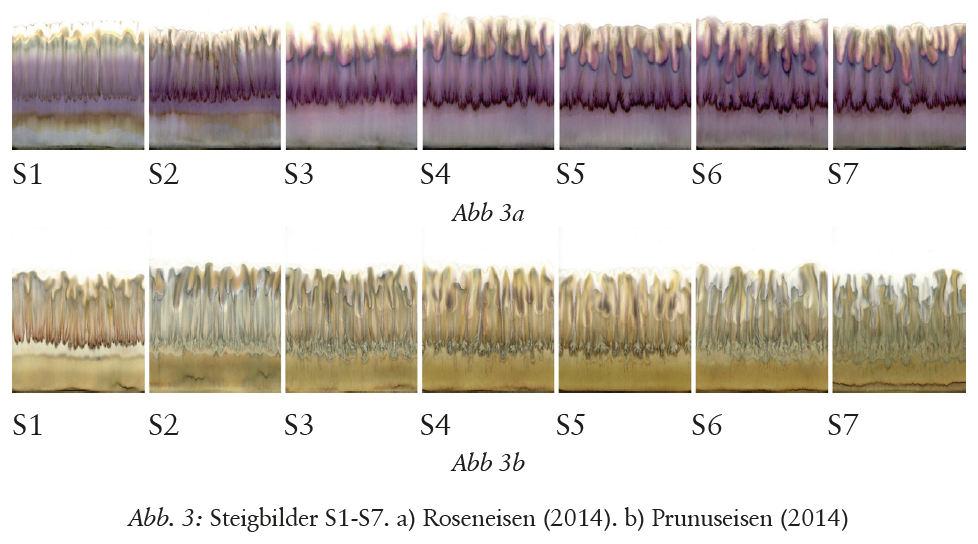
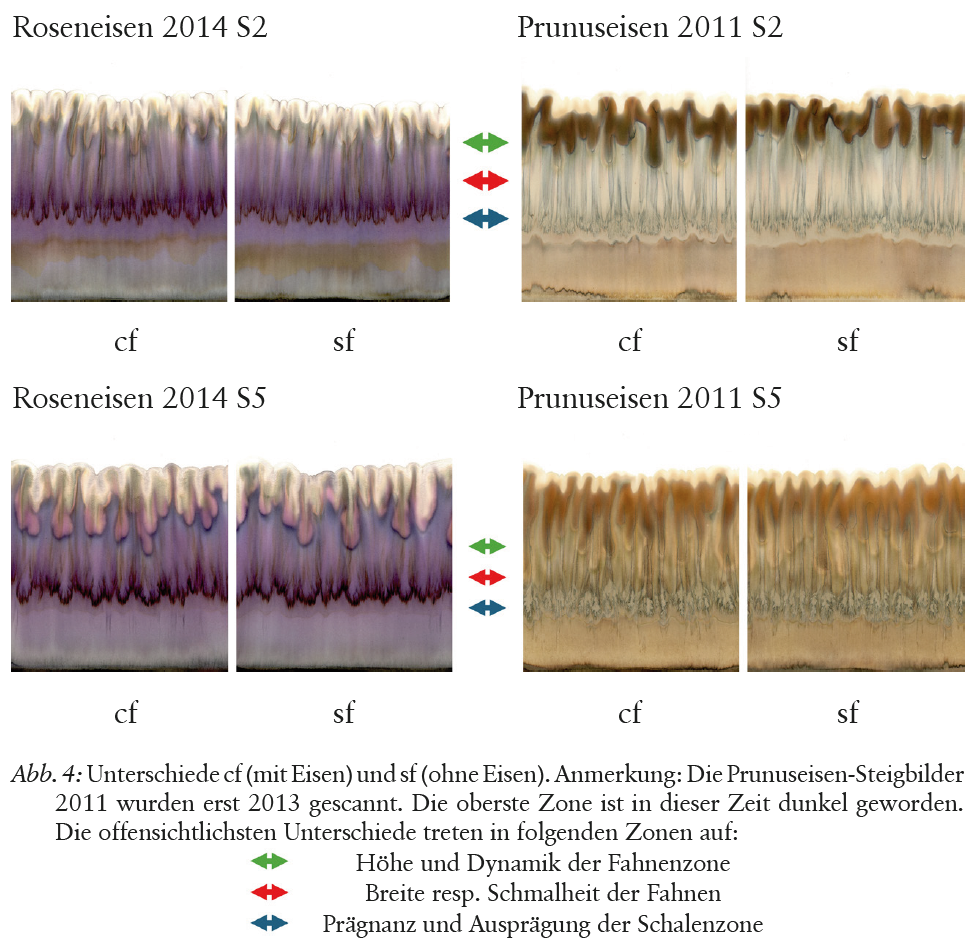
As part of the basic research conducted by WALA Heilmittel GmbH, the influence of adding iron during the rhythmic production of the WALA mother tinctures ‘Roseneisen’ and ‘Prunuseisen’ was investigated. Differences between samples with and without added iron were identified and characterised based on smell and rising pictures. Conventional analytical methods did not reveal any significant differences. Rhythmisation is a process used, inter alia, to bring out and specify the medicinal qualities of plants and to preserve the aqueous extracts. Rhythmisation provides the metabolic potentials present in the mother tincture with environmental conditions in which the harvested plants and their microbiome can continue to develop. The rising picture method also offers the mother tincture the possibility to metabolise and to cover the paper with deposits of substances, within the limited time and chemical conditions of the rising process. Dynamic aspects of substance compositions can be recorded and interpreted with an appropriate evaluation. The studies show that in the presence of iron the further development of the mother tinctures is dynamized and intensified.
References
  • Belitz, H.-D. et al. (2008): Lehrbuch der Lebensmittelchemie. 6. Aufl. Heidelberg.
  • Engel, W. et al. (2014): Pflanzensaure Eisenpräparate – Ausgangssubstanzen pflanzlichen und mineralischen Ursprungs. Der Merkurstab 4/2014, S. 270–282.
  • HAB (2014): Homöopathisches Arzneibuch. Vorschrift 37a–b: Wässrige Urtinkturen mit Wärmebehandlung und Fermentation.
  • Held, W. (2022): Die Schönheit rettet die Welt. Das Goetheanum 27, S. 6.– 11.
  • Hornbergs, J. et al. (2023): SEC14-GOLD protein PATELLIN2 bind IRONREGULATED TRANSPORTER1 linking root iron uptake to vitamin E. Plant Physiology 192, S. 504–526.
  • Kaim, W., Schwederski, B. (2010): Bioanorganische Chemie. Zur Funktion chemischer Elemente in Lebensprozessen. 4. Aufl. Wiesbaden.
  • Meyer, U. et al. (2014): Herstellung und therapeutischer Einsatz pflanzensaurer Eisenpräparate. Der Merkurstab 6, S. 436–447.
  • Paffrath, V. et al. (2024): A major role of coumarin-dependent ferrix iron reduction in strategy I-type iron acquisition in Arabidopsis. The Plant Cell 36, S. 624–664.
  • Schmidt, H. et al. (2014): Metabolome Analysis of Arabidopsis thaliana Roots Identifies a Key Metabolic Pathway for Iron Acquisition. PLoSONE 9(7): E 102444. https://doi.org/10.1371/journal.pone.0102444.
  • Steiner, R. (1921): Vorträge und Kurse über christlich religiöses Wirken II. Vortrag vom 05.10.1921. Dornach, GA 343.
  • Vogel, H.-H. (2000): Wege der Heilmittelfindung. 2. Aufl. Bad Boll.
  • Waldburger, B. (2022): Roseneisen und Prunuseisen – Einfluss der Hämatit- Zugabe bei der Herstellung der Urtinkturen mit dem rhythmischen Verfahren nach WALA. Gesamt-Projektbericht. WALA Heilmittel GmbH, Grundlagenforschung.
  • Waldburger, B. (2023): Faszination Steigbilder. Ästhetik, Auswertung, Bildsprache. Frankfurt am Main.
  • Waldburger, B. (2026): Steigbilder – wiederholte Betrachtungen. Elemente d. N. 125, Dornach, in Vorbereitung.
  • Wikipedia (02.12.2025): Anthocyane